Showing posts with label NASA. Show all posts
NASA's Voyager Spacecraft That Toured Outer Planets Nearing Solar System Edge!
In 1977, Jimmy Carter was sworn in as president, Elvis died, Virginia park ranger Roy Sullivan was hit by lightning a record seventh time, and two NASA space probes destined to turn planetary science on its head launched from Cape Canaveral, Fla. NASA's twin Voyager spacecraft toting identical University of Colorado Boulder instruments are nearing the edge of the solar system. Lab Spaces 1 hour ago NASA's Voyager spacecraft that toured outer planets nearing solar system edge.
The First Successful American Satellite on 31th January in 1958!
Launched less than two months after Vanguard 1A, the first American attempt to compete with Sputnik, blows up on the launchpad, Explorer 1 (officially called Satellite 1958 Alpha) achieves an orbit extending an astonishing 1,560 miles (2,500 kilometers) above the Earth. This leads to the first great scientific discovery of the space age, when instruments designed by Iowa physicist James Van Allen find the radiation belts now named in his honor. The 31-pound (14-kilogram) satellite transmits until May 23, when its batteries die, but it remains aloft for more than 12 years.From: National Geographic
The First Animal in Orbit on 3rd November in 1957!
Having stunned the world with the first orbital space launch, Sputnik 1, less than a month before, the Soviet Union tries for a second coup by launching a dog named Laika on a one-way journey on a hastily completed follow-up mission, Sputnik 2. The dog survives the launch, but Soviet secrecy masks her ultimate fate for many years. It now appears that even though she had a week's supply of food, Laika died within hours, possibly due to a life-support failure that caused her canister to overheat.From: National Geographic
First Artificial Satellite 4th October in 1957!

The Soviet Union ushers in a new era the space age with the launch of Sputnik 1. A technological feat, the beach ball size satellite weighs 184 pounds (84 kilograms) and takes 98 minutes to orbit Earth. The launch grabs the world's attention and catches the U.S. off-guard. The first successful American satellite doesn't get off the ground until January 31, 1958.
NASA Visualization Explorer for iPad on the iTunes App Store!
The NASA Visualization app is your window into the world of NASA research. NASA has released an app for the iPad called NASA Visualization Explorer or NASA Viz for short.
File Name: NASA Visualization App.
File Updated: Aug 10, 2011.
File Version: 1.0.2.
File Size: 4.8 MB.
File Language: English.
File Seller: NASA.
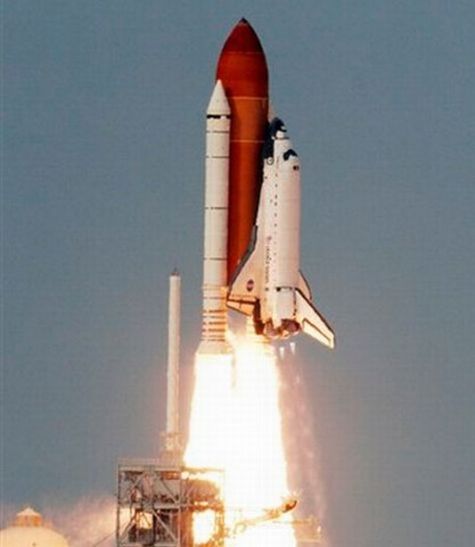
Comming 8th July NASA STS-135 Mission Begin For Final Flight !
Space shuttle Atlantis is set to liftoff for the final flight of the shuttle program. 'STS-135' a 12-day mission to the International Space Station. Launch is currently targeted for July 8.In 2010 NASA Authorization directs NASA conduct the STS-135 mission. The Space Shuttle Program has added on the mission to the manifest to decorate for a potential target launch date in early July in this year.
The Raffaello multipurpose logistics module to deliver supplies which will be carry by Atlantis. Atlantis also carry Logistics & spare parts to the International Space Station. The mission also will fly a system for investigate the potential for robotically refueling existing spacecraft and then return a failed ammonia pump module to help NASA better understand the failure mechanism and improve pump designs for future systems.
From: Nasa.
In This Year Last ISS Tour photo And Video Collection From NASA!
Last April on 2011, The Sky Exploration Institute of NASA finished Expedition 27 Flight on ISS Tour. They published some Photo and Video which they collected. Collected Expedition 27 Flight Engineer Cady Coleman flies through the International Space Station with a High-Definition video camera. This Photo and Video Collected from ISS tour 21 April in 2011.From: Nasa.
Apollo 11 Mission Summary!
Apollo 11 Mission History is known by all nation in the whole world. The purpose of the Apollo 11 mission was to land men on the lunar surface and to return them safely to Earth. It was the first mission for NASA. Apollo 11 manned space flight mission. Kamanin writes that Apollo 11 has completed its lunar mission successfully.Down to 50,000 feet above the Moon, Apollo 11 was little different from 10. Armstrong, Aldrin, and Command Module Pilot Mike Collins had a flawless launch from Earth, a long, uneventful coast out to the Moon, and a nominal engine burn to put themselves into lunar orbit. As they crossed over the Sea of Tranquility for the first time, Armstrong remarked that "the pictures and maps brought back by Apollo 8 and 10 have given us a very good preview of what to look at here. It looks very much like the pictures; but, like the difference between watching a real football game and watching it on TV, there's no substitute for actually being here._ By NASA
Free-Floating Planets May Be More Common Than Stars!
Astronomers, including a NASA-funded team member, have discovered a new class of Jupiter-sized planets floating alone in the dark of space, away from the light of a star. The team believes these lone worlds were probably ejected from developing planetary systems.The discovery is based on a joint Japan-New Zealand survey that scanned the center of the Milky Way galaxy during 2006 and 2007, revealing evidence for up to 10 free-floating planets roughly the mass of Jupiter. The isolated orbs, also known as orphan planets, are difficult to spot, and had gone undetected until now. The newfound planets are located at an average approximate distance of 10,000 to 20,000 light-years from Earth.
"Although free-floating planets have been predicted, they finally have been detected, holding major implications for planetary formation and evolution models," said Mario Perez, exoplanet program scientist at NASA Headquarters in Washington.
The discovery indicates there are many more free-floating Jupiter-mass planets that can't be seen. The team estimates there are about twice as many of them as stars. In addition, these worlds are thought to be at least as common as planets that orbit stars. This would add up to hundreds of billions of lone planets in our Milky Way galaxy alone.
From: NASA
Hubble Views the Star That Changed the Universe!
Though the universe is filled with billions upon billions of stars, the discovery of a single variable star in 1923 altered the course of modern astronomy. And, at least one famous astronomer of the time lamented that the discovery had shattered his world view.The star goes by the inauspicious name of Hubble variable number one, or V1, and resides in the outer regions of the neighboring Andromeda galaxy, or M31. But in the early 1900s, most astronomers considered the Milky Way a single "island universe" of stars, with nothing observable beyond its boundaries. Andromeda was cataloged as just one of many faint, fuzzy patches of light astronomers called "spiral nebulae."
Were these spiral nebulae part of the Milky Way or were they independent island universes lying outside our galaxy? Astronomers didn't know for sure, until Edwin Hubble found a star in Andromeda that brightened and faded in a predictable pattern, like a lighthouse beacon, and identified it as V1, a Cepheid variable. This special type of star had already been proven to be a reliable distance marker within our galaxy.
From: NASA
NASA's Hubble Finds Rare 'Blue Straggler' Stars in Milky Way's Hub!
NASA's Hubble Space Telescope has found a rare class of oddball stars called blue stragglers in the hub of our Milky Way, the first detected within our galaxy's bulge.Blue stragglers are so named because they seemingly lag behind in the aging process, appearing younger than the population from which they formed. While they have been detected in many distant star clusters, and among nearby stars, they never have been seen inside the core of our galaxy.
It is not clear how blue stragglers form. A common theory is that they emerge from binary pairs. As the more massive star evolves and expands, the smaller star gains material from its companion. This stirs up hydrogen fuel and causes the growing star to undergo nuclear fusion at a faster rate. It burns hotter and bluer, like a massive young star.
The findings support the idea that the Milky Way's central bulge stopped making stars billions of years ago. It now is home to aging sun-like stars and cooler red dwarfs. Giant blue stars that once lived there have long since exploded as supernovae.
The results have been accepted for publication in an upcoming issue of The Astrophysical Journal. Lead author Will Clarkson of Indiana University in Bloomington, will discuss them today at the American Astronomical Society meeting in Boston.
From: NASA
Subscribe to:
Posts (Atom)